Showing posts with label professional photographer. Show all posts

Saturday, 15 February 2014

OUT OF SIGHT IS OUT OF MIND ... AND OUT OF POCKET: Why visual communication is vital

By Erika Kruger


Out of sight is out of mind!

So often, familiar expressions such as these convey important life and business lessons. 

Being out of customers’ minds can leave business owners seriously out of pocket.

Any business that is not harnessing the power of visual communication will soon discover that their services or products are not uppermost in the buyers’ minds. If our business or our brand is not in direct view of our target market, it is easily forgotten. People tend to stop thinking about things that they don’t often see.

Worse than being forgotten, is being lost in obscurity. If consumers have never seen you around, out of sight, out of mind actually means that you just do not exist and they have no idea that your business can be of service to them.

Now that badly affects the bottom line. 

It leaves you out of pocket.

Yes another stock phrase but one that boasts two different meanings these days.

The conventional use comes from an accounting term to pay from ones personal funds, something us business owners are going to end up doing if we don’t push ourselves to see and be seen quickly and effectively.  

The other, more recent meaning of being out of pocket often used in Silicon Valley and implying that someone is unavailable, that we are no longer in other people’s pocket. 

It also suggests that no-one can get hold of us in any way possible – not via email, not via telephone and not via cell phone. We have isolated ourselves.

But that may not be the only way we are playing hard to get.

 Feeling invisible? 

Our customers might find it hard to get what our business is all about.  Our brand message could be getting lost in:
  •      too much text,
  •      bad design and
  •      poor quality, bland and badly chosen images.

Read also: IMAGES CAN MAKE OR BREAK A WEB PAGE: Using images to put the brake on a speedy click through


 Do you feel your business is being overlooked? Is your business playing hard to get?

Are your branding, marketing, advertising and PR campaigns failing to harness the power of high quality and appropriate images to keep you in direct vision of your customers?  

5 things you could do:

If you answered yes to those questions, this will help you improve your business' visibility: 
  • Learn a new language. Become visually literate.
  • Invest in the best visual communication team you can afford – designers, web designers, photographers etc. 


Remain in your customers’ sight and minds so that you can find a place in their hearts.

Wednesday, 6 November 2013

SO, WHICH WAY WOULD YOU LIKE ME TO FACE? 5 facts about a portrait sitting your (conscious) mind was unaware of


‘So which way would you like me to face?’

A question every photographer about to shoot a professional portrait, is asked as soon as the model arrives in the studio.

The problem is that there is no simple answer to this seemingly simple question. Should the photographer:
  • Position the client according to the lighting configuration he or she has set up to achieve a particular outcome or because the location demands it?
  • Accommodate the client’s preference for a particular side? People often feel they have a good side that looks better on a photo.
  • Take into account facial features that might make the image less aesthetically pleasing e.g. turning the model’s head so that a larger eye is further away from the camera?
  • Listen to what neuro-anatomists and cognitive psychologists tell us about portraits?

What your subconscious knew but did not tell your conscious mind 

Here are 5 interesting facts about portraits that you probably don’t know. At least not your conscious mind but if you had to dig up some old photographs, you see that your subconscious had known a thing or two all along.

1. Most of the time we choose to be photographed with the left side of our face, facing the camera. Why? Not because of any cosmetic or physical attributes that we favour but because the left side of our faces show more emotion than the right and we are hard-wired to experience intense emotional responses more aesthetically pleasing. According to a study published in Experimental Brain Research the left side of the face shows more muscle movement in response to emotions. That is because the right cerebral hemisphere tends to be more involved in the perception and production of emotion than the left.1) And more emotion makes for better portraits, the theory goes.


2. The left-side bias has been known to naturalists and artists for a very long time. The theory of that which we seem to instinctively know about portraits, has been the topic of neuro-anatomy and art theory for hundreds of years. It was Darwin who first observed that the two sides of the face do not move and express emotion in the same way. His observations have since been confirmed by experimental and physiological studies. 2) For example in their study Turning the left cheek, researchers McManus and Humphrey indicate that 60 % of portraits painted since the 16th century show the left side of the sitter’s face. 3) We seem to prefer seeing and rendering a person’s more emotional side in a painted portrait. And the same goes for photographs.


3. But not always! We seem to have a different face bias for self-portraits depending on whether we are artists or non-artists. According to Bruno and Bartomini’s surveys of art books and exhibitions, show the majority of artists featuring the right side when composing a self-portrait, a phenomenon that is considered an art convention. Historically, painting or drawing a self-portrait required working of your own image reflected in a mirror. This method reverses the image you work from hence the right side bias. Nowadays artists most probably work from photographs which in the long is bound run to change the self-portrait posing conventions taught at art school. 4) This is what neuropsychologists Nicola Bruno and Marco Bertamini found when they observed people using smart phones to take ‘selfies’. Non-artists prefer the left side more often than the right even if you have to contort your body to get the shot. 5)


 4. Portrait type, social position and career choice also influence our choice of left or right facing portraits. When we are posing for a more informal family portrait when go for the more emotionally expressive left side. 2) But there are times when the sitter prefers to not show their softer, sensitive sides. It might be for reasons of status, for professional reasons or as a result of convention. Several studies have shown that natural scientists, chemists and engineers tend to show their less emotional right side ‘more in keeping with the stereotyped pose of a professional rationalist’. 3) Academics in the human sciences e.g. language and psychology departments tend to show the left side of the face probably feeling more comfortable showing their most emotional aspect to the world, unlike the engineers who want to ‘appear more rational and suggests that these hard scientists seek to display themselves to the world as the unemotional clichés of popular myth’. 3)


5. Sex may also help determine the cheek of choice - Male academics in the Churches tend to prefer showing the right cheek while female academics tend to show the left cheek more often. It is possible that the observed biases were the result of ingrained cultural and stereotypical gender roles depicting women as more emotional than men 2)
References:

Wednesday, 13 February 2013

TRAVELLING SHOW: Kapula takes Martin Van Niekerk Photography's images abroad


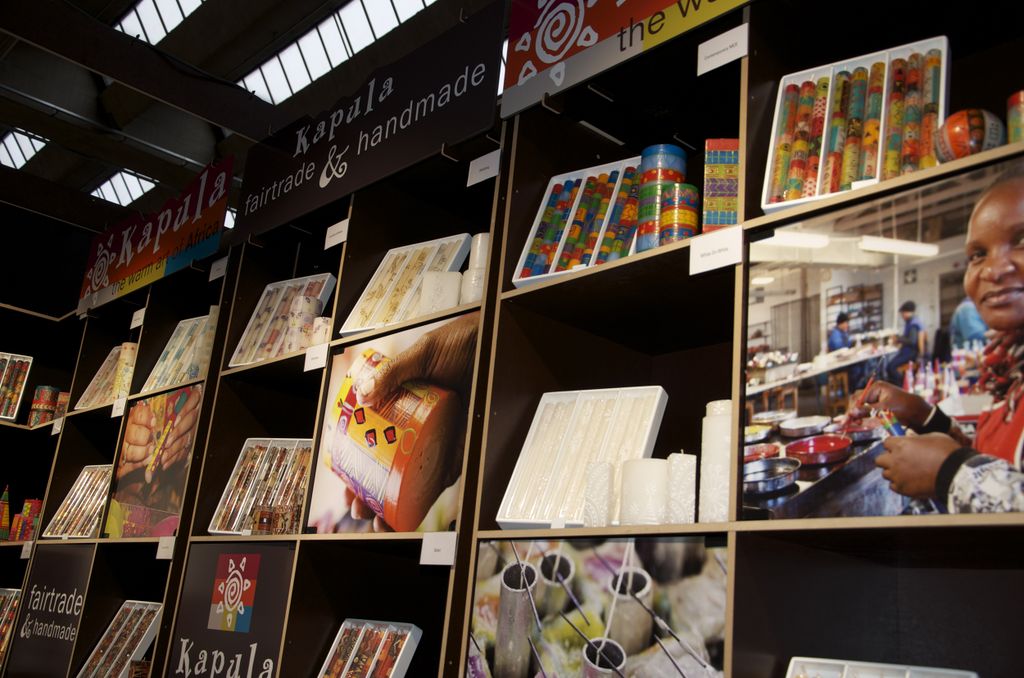
Kapula's stand with my images and their hand-made candles at the
2103 Christmas Fair in Frankfurt, Germany earlier this year
If only this photographer could travel the world, the way the images I create for my clients, do!

Earlier this year Anke Appelgryn and the Kapula team trekked northwards from Bredasdorp to an icy cold Germany with their hand-made candles to participate in a major trade fair known to set international trends for festive decorations for the coming season.

And with it went several of the images I had shot for them, blown up to poster-size, to decorate the Kapula stall!

The 2013 Christmasworld expo took place from 25 to 29 January in Frankfurt and offered exhibitors from 66 countries an opportunity to introduce their products to the wholesale and retail trades including shops, florists, interior decorators and shop window specialists and designers. 


According to the organisers’ final report, Christmasworld 2013, with the two other expos that run concurrently namely Paperworld and Creativeworld, drew exhibitors from 66 countries and 83 600 visitors from 145 countries.

The Cristmasworld trade fair comprises ten different product groups including candles and fragrances. The others were Christmas decorations, annual and seasonal festive decoration (e.g. Easter, Halloween and religious objects), ribbons and wrapping, decorative gifts, florists' requisites, festive lighting, shop and display accessories, fireworks, party and festive articles.

Thanks Anke for supplying the photographs of the stall. It is great seeing my images helping to promote an exceptional product.  May the visitors’ visual experiences be converted into massive orders!


Close-up shots of the images


The Kapula stall

Monday, 5 November 2012

Wednesday, 12 September 2012

RENE IS READY FOR REDKEN: Esri

Rene Erwee of Salon Elan's second entry for the Redken Ultimate Chromatics Haircolour Contest is red hot, three shades of red to be exact! It turned out just the right combination to emphasise model Esri's beautiful blue-green eyes.

Photographer: Martin Van Niekerk
Hair stylist: Rene Erwee, Salon Elan in Somerset West
Model: Esri
MAU: Candice Harker
Esri before and after
Rene does last minute adjustments to Esri's hair ...
... and her lips.


Monday, 3 September 2012

ASSIGNMENT KAPULA CONTINUED ...

After our visit to Bredasdorp to document the workings of Kapula, Martin and Kapula's marketing manager Anke Appelgryn continued the work in the MVNP Studio in Strand near Cape Town. Every range of candles and ceramic ware had to be photographed for the website and believe me there are many, one as exquisite as the other.  

Photographs: Erika Kruger


Kapula - The warm art of Africa

Anke and Martin setting up in the MVNP Studio in Strand

Lining up the candles ...

... while the next batch is already busy with a practice run in the background.

KAPULA CANDLES: THE WARM ART OF AFRICA

 In April this year we visited the Kapula Candles-team in Bredasdorp near the southernmost point of Africa, to take photographs of the Kapula people, products and processes for their new website and promotional material. 

Thanks to the friendliness and enthusiasm of marketing manager Anke Appelgryn and every other member of the Kapula team, it didn't feel like we were working at all. 

Here are a few photographs that tell the story of our visit. 


Anke and Ilse Appelgryn. Ilse started making candles in her garage in 1993 and today it has grown into a thriving business which embraces the principles of  the World Fair Trade Organisation

From the smiles, it is clear that this assignment was not hard work! I had to shoot a portrait of each and every Kapula employee (96 people from four different locations in all). Thanks to marketing manager, Anke's ability to plan and organise and everyone's willingness to participate, we managed to complete the task in four hours.


The candles are hand-made and hand-painted by experienced workers using wax and pigment and a very steady hand.

The workshop where the candles are made. I had to contend with very low light as well as a fine, clingy mist caused by molten wax. The equipment survived!

The coloured wax turns even ordinary tools into works of art.

An experienced candle painter with a sample board showing one of many combinations of patterns, textures and colours in the Kapula candle range


The workshop where the candles are painted offered an endless supply of photo opportunities.

Production team, marketing team and design team meet. 


Besides candles, Kapula also creates hand-crafted ceramics and tableware.

Special people and special products


Each item's design is hand-drawn before the glazes are added.

Martin among the ceramics painters


Background photographs by Erika Kruger

Monday, 27 August 2012

FACING UP TO SOCIAL MEDIA PORTRAITS


Why professional people need to post images on social media profiles


Should I or shouldn't I spend the money to employ a professional photographer for social media profile portraits? In fact, why bother adding an image to my social media profiles at all? 

www.shuftipics.co.za

When asked, most people will tell you that we join social media such as LinkedIn, Facebook and Twitter to network. We want to grow our businesses and extend the reach of our brands.

But what we are really doing is making friends. We want to foster friendships that can help us achieve our business goals. But also chums we can chat to because we like them and we like what they do. Social media makes it possible for us to link up with people we may never have met in places we would never get to in real life. Once we have got to know one another better, sooner or later we might do business together. 

Research has shown that twitter accounts with a profile picture have ten times more followers that those without.

How do we go about connecting with new people and colleagues on social media? 


Well, it seems the same way as we would in real life - we want to look them in they eye. From infancy, human beings are hard-wired to recognise faces.  There are billions of people on earth and many share the same name but each person’s face looks different. Recognising faces is a very complex process combining cognitive and emotional aspects to not only identify a face but also to interpret feelings.

If beauty is in the eye of the beholder, so is credibility and integrity it seems.

The first thing we do when scanning a person’s face whether in the flesh or on a social media page, is to focus attention on the eyes, or to be more accurate in the vicinity of the eyes. What we are really doing is ‘reading’ the other person’s eyebrows. According to some researchers, eyebrows seem to do more than protect the eyes against rain and perspiration. It acts as important visual markers during face recognition, when expressing emotions and social signals and therefore in voluntary and involuntary non-verbal communication. We convey a number of different emotions by merely moving our eyebrows such as confusion, astonishment, anger. Just think how effective eyebrows are used in the different emoticons we use in electronic communication. The eyebrows also add to the aesthetics of faces and help us distinguish between sexes.

Once we have ‘read’ the face, our decision as to whether or not we like and trust that person happens lightning fast. And according to Graham Jones in his blog InternetPsychology we make a decision within 100 milliseconds. So it seems it really is true that we have one and only one, very short, chance to make an impression.

It is therefore vital that we have a full face portrait picture on all our social media profiles but it follows that the kind of image we have on our website or on our social networking profiles will influence whether people wish to connect with us.

What must this portrait picture look like?


What should this photograph that is strong enough to impress a visitor to my website or social profile look like?  

Understanding that our eyes are instantly drawn to someone else’s eyes, it makes sense to rather use a head-and-shoulders portrait rather than a full body shot. In fact researchers from the Hebrew University of Jerusalem tell us exactly what our profile pictures need to look like to foster trust. According to these experts we all prefer looking at a baby-faced image with the wrinkles ironed-out.

But hold on! Before cranking up Photoshop to smooth out and flesh out those portrait photographs, (unless you do it for a living) and probably ending up looking nothing at all like your real life self, there is safer way of ‘enhancing’ profile photo. Why don’t you consider the services of a professional photographer?

Why bother with paying a professional photographer for an image you are going to use on social media? 
As a professional or businesses owner, you are your brand. Everyone of your actions conveys a message. Everything you do and everything you say becomes an expression of your brand. So does the way you look. And knowing what we know about how humans appraise each other on sight, your visual representation is vital. This is especially so on social media where you have only one chance at making an impression and that in a tiny square next to your name.

Just as a graphic designer aligns your corporate identity with the brand objectives and the career copywriter helps you take control of your written and spoken communication, employing a professional photographer provides you with appropriate profile photographs and other images that convey appropriate and effective visual messages.

 What makes a professional photographer’s images so special?


The obvious reasons include the professional photographer’s superior equipment (a cell phone image just can not compare with a professional cameras and lenses), technical experience to project your image in the best possible light (literally) and professional skills to set you at ease and take up as little of your valuable time as possible.

But it is the combination of all of these factors that makes the real difference. In some ways, photography is like gardening. It is the sequencing of steps, one building on the other, that creates a magnificent final product.

The process of taking a professional portrait starts before the shoot, not during the shoot and definitely not with the digital manipulation process afterwards. The success of each step is influenced by many factors starting with a clear brief and thorough preparation by both the subject and the photographer. The two of you have to select the right time, the appropriate (but original) setting, the appropriate outfit and whether make-up and hairstyling is required.

Besides turning up looking your best on the day, there is not much more you need to do. It is up to the photographer to create a portrait that will jump-start the conversations on social media.

Next time we will look in detail at how to prepare for a portrait shoot.