Showing posts with label Cape Town. Show all posts

Wednesday, 11 June 2014

FLASHBACK # 8: Corvette / 2011

PHOTOGRAPHER: Martin Van Niekerk
CLIENT: Garage Magazine, September 2011
PUBLISHER & EDITOR: Barry Ashmole of  The Garage, Classic Custom Creations, Blaauwklippen Road, Stellenbosch 
GRAPHIC DESIGNER (Page Layout): Ronel Van Heerden, NineNinetyinNine, Strand
MODEL: Katerina, Ice Model Management


Saturday, 15 February 2014

OUT OF SIGHT IS OUT OF MIND ... AND OUT OF POCKET: Why visual communication is vital

By Erika Kruger


Out of sight is out of mind!

So often, familiar expressions such as these convey important life and business lessons. 

Being out of customers’ minds can leave business owners seriously out of pocket.

Any business that is not harnessing the power of visual communication will soon discover that their services or products are not uppermost in the buyers’ minds. If our business or our brand is not in direct view of our target market, it is easily forgotten. People tend to stop thinking about things that they don’t often see.

Worse than being forgotten, is being lost in obscurity. If consumers have never seen you around, out of sight, out of mind actually means that you just do not exist and they have no idea that your business can be of service to them.

Now that badly affects the bottom line. 

It leaves you out of pocket.

Yes another stock phrase but one that boasts two different meanings these days.

The conventional use comes from an accounting term to pay from ones personal funds, something us business owners are going to end up doing if we don’t push ourselves to see and be seen quickly and effectively.  

The other, more recent meaning of being out of pocket often used in Silicon Valley and implying that someone is unavailable, that we are no longer in other people’s pocket. 

It also suggests that no-one can get hold of us in any way possible – not via email, not via telephone and not via cell phone. We have isolated ourselves.

But that may not be the only way we are playing hard to get.

 Feeling invisible? 

Our customers might find it hard to get what our business is all about.  Our brand message could be getting lost in:
  •      too much text,
  •      bad design and
  •      poor quality, bland and badly chosen images.

Read also: IMAGES CAN MAKE OR BREAK A WEB PAGE: Using images to put the brake on a speedy click through


 Do you feel your business is being overlooked? Is your business playing hard to get?

Are your branding, marketing, advertising and PR campaigns failing to harness the power of high quality and appropriate images to keep you in direct vision of your customers?  

5 things you could do:

If you answered yes to those questions, this will help you improve your business' visibility: 
  • Learn a new language. Become visually literate.
  • Invest in the best visual communication team you can afford – designers, web designers, photographers etc. 


Remain in your customers’ sight and minds so that you can find a place in their hearts.

Tuesday, 31 December 2013

NEW YEAR IN CAPE TOWN IS CARNIVAL TIME!

By Erika Kruger

In Cape Town  New Year celebrations are associated with the Kaapse Klopse or Minstrels taking to the city streets in a high intensity burst of energy in their colourful outfits and variety of musical instruments. 

Later in the year the different troupes also participate in the annual Cape Town Carnival.

In 2010 Martin was assigned to documented the carnival in March and in June of the same year, he also photographed the Cape Town Street Festival held to welcome the 2010 Fifa World  Football event to the city.

Here are some of the images from those two memorable events.


Saturday, 31 August 2013

IMAGES CAN MAKE OR BREAK A WEB PAGE: Using images to put the brake on a speedy click through


An image strategy can make
or break the usability of your web site
 
Images can make or break a web page.    
Big companies know this and small businesses know this! You will seldom come across a web page without images or graphics.

But often it is very obvious that not much thought has gone into selecting the images that must communicate the company’s message. It lacks an overall strategy that integrates not only design elements (the relationship between text and images) but also the company’s brand strategy with the design approach.

Typically the small business owner will provide the text and the designer will put together the website.

Then at some point during the process, the topic of image comes up and one of a number of actions might follow:

  • Best case scenario: A professional photographer is called in to document company products, people and installations

  • Second-best case scenario: The business supplies its own images that might or might not be substandard quality or outdated or in appropriate and the handiwork of employees on site or whoever is in charge of marketing.

  • Worst case scenario: The designer opts to purchase stock images to illustrate the website.

  • Ultimate worst case scenario: The designer illegally downloads images of the Internet.

 I can already hear you say that this is all conjecture and that it shows my bias towards employing professional photographers like us. 

And you will be right.

But hear me out, I have support from good authority.

There are at least three aspects to take into account in developing an image strategy for a web site:
  • the relationship between the text and the images
  • where the images are placed and
  • the type of images selected

Is your web site a yapper or a looker?


It seems we spend only about 10 to 20 seconds perusing a site before we click on the next one. Not much of a window of opportunity to capture a viewer’s attention.

Clearly large chunks of text will not improve retention rates. Ask yourself, how many words are we able to read and absorb in 10 to 20 seconds?  

And more importantly, how many words are we willing to read to find out what a web page is all about?

Well, simply not enough to convert the browser into a buyer as effectively as good images. A picture tells a thousand words, the saying goes.

Location, location, location


In fact, according to Jakob Nielsen, an expert on web page usability and partner in the Nielsen Norman Group of California, we don’t read web sites at all. We scan them and in ways very different from how we were taught to read at school. 

Studies by the Nielsen Norman Group on how our eyes move across the screen when viewing web pages, indicate that we generally do this in an F-shaped pattern - two horizontal stripes followed by a vertical stripe. 

Therefore:
  • the most important information must be contained in the first and second paragraphs (the two horizontal stripes of the F) and
  • the vertical stripe on the left has to be used for subheads and bullet points with information-carrying words.

 Keeping this in mind it is clear that the placement of images also cannot happen randomly but should contribute to the overall usability of a website.

An image of substance


Also not all images are equal says the Nielsen Norman Group. Users seem to pay close attention to images that ‘contain relevant information but ignore fluffy pictures used to "jazz up" Web pages.’ 

Their studies have shown that purely decorative images are by and large ignored while images of products and real people (rather than stock photos and models) are considered important and people spend time examining them.

And the photographer makes three ...


Relating these findings to the four scenarios I discussed earlier, want to add another option.

Rather than treating the images on your web site as an incidental element, a purely decorative feature or as a design afterthought, include a professional photographer in the conceptualising and planning from the start.

Give us a call and let us help you develop an image strategy that will make your web site and which will put the brakes on viewers hurriedly clicking through.

Ps: 1 November 2013

This what Internet tool company, VIGO has to say on the topic in an articel, The Death of the Homepage:

Up the visuals

It’s no secret that our attention spans have waned. We’ve grown to love colorful (sic) visuals and catchy excerpts of words, so long as they remain short. When branding a homepage, it’s important to avoid using long, drawn out descriptions and to make sure the homepage visually represents the brand we want our company, product or service to convey. The homepage and internal pages should combine professionalism with beauty, which means using little content to say a lot and creating a layout that’s intuitive and easy on the eyes.    


Monday, 12 August 2013

ARTFUL AIKIDO: Slow shutter speed sword sequences

When Hans Menck of Freedom School of Martial Arts in Cape Town, asked us to take photographs for his new website, we expected to shoot only straight forward sequences of the different attacks. 


But when designer and art director Ronel Van Heerden of NineNinetyNine and I suggested a more interesting approach using slow shutter speeds for some images, Hans very enthusiastically said yes! 

And this is the result.


Wednesday, 19 June 2013

MVNP STUDIO SHOOT, STRAND / SOMERSET WEST: Tanita


Photographer: Martin Van Niekerk
Model: Tanita
MUA: Charyke Steyl Coetzee


Photographer: Martin Van Niekerk
Model: Tanita
MUA: Charyke Steyl Coetzee


Photographer: Martin Van Niekerk
Model: Tanita
MUA: Charyke Steyl Coetzee


Photographer: Martin Van Niekerk
Model: Tanita
MUA: Charyke Steyl Coetzee


Photographer: Martin Van Niekerk
Model: Tanita
MUA: Charyke Steyl Coetzee


Tuesday, 21 May 2013

PRESENTING YOUR PRODUCT IN A GOOD LIGHT - Why a good grasp of lighting is vital for product images

In a previous post I remarked that employing a professional photographer to do product photography does not have to break the bank as it does not involve special lighting effects, intricate angles or extensive styling.

Still, a good grasp of lighting will always remain fundamental to all types of photography including product photography. Even static, straight forward lighting requires the right equipment, and a thorough understanding of how light works. 

As important is positioning of the objects and the choice of background. But more about that next time.

Photographers manipulate light to achieve the effects they and their clients require. By adjusting the angle of the lights and their intensity as well as altering the object’s position, the photographer can make your product look appealing and desirable.  


When do images NOT present your product in the best possible light?


  • It is difficult to get a clear picture of a product in a dimly lit image. It may be blurred and important detail may be obscured. Dark and fuzzy pictures may even signal to a customer to beware, that you have something to hide. 


It is difficult to see finer detail and the actual colour of the watch face, important information for a potential customer who relies solely on the visual features of a product to make a decision.

  • On the other hand, over-exposed images result in hot spots with features and details that look washed-out.  Lighting that is too bright also throws harsh, solid shadows that detract the viewers’ eyes from the product itself.


In this image, information is lost in the overexposed areas.

  • Over-exposed images are often the result of using an on-camera flash. Moreover, as the light source is concentrated in one place, there will inevitably be aspects of the product that will not be highlighted and become ‘lost’ in the photograph. 


A large amount of information is lost in this image as an on-camera flash cannot
light an entire object evenly. Notice how the face is lit but the watch strap is dark
and fuzzy. The customer is not able to see the entire product clearly.


What is different about a photograph by a professional photographer?


Adding more than one light source e.g. from the side and / or the back, is what gives professional photographers’ images the edge. It prevents some areas from being dark and obscured but also gives depth and crispness to an image that an on-camera flash cannot. 

Using more than one light source in a controlled environment results in a clear,
bright and aesthetically pleasing image, providing all the information needed to
convert a viewer into a buyer.
Usually the controlled environment of a studio or a makeshift studio on location, makes it easier to achieve aesthetically pleasing images that give the viewer all the information needed to make a choice.

The studio also gives the photography better control over colour castings and unflattering reflections either from the backdrop and surroundings onto the object or the other way round. 

While at times natural warm light could be a good choice for products, the photographer still has to understand how to control it.


Next time more about backdrops, positioning of products and 
choosing the best angles.

Monday, 29 April 2013

KISS CURLS: Salon Elan, Somerset West


Photography & Retouching: Martin Van Niekerk
Model: Candice
Hair Styling: Rene Erwee, Salon Elan, Somerset West
MUA: Louna Esterhuizen Van Zyl of Make-up by Louna
Salon Elan, Somerset West


Before and after

One model, three looks

Monday, 18 March 2013

PORTRAIT OF A PRINT MAKER


Artist Leonora Van Staden of Stellenbosch

I recently did a portrait shoot for award-winning Stellenbosch print artist, illustrator, lecturer and recently furniture designer, Leonora Van Staden in a beautiful historical building in the town centre. This is one of the images.

Friday, 8 March 2013

PHOTOGRAPHY AFFECTS ONLINE SALES - Our argument supported by result of eposure survey of attitudes to photography


In our previous post we reasoned that high quality images can influence company’s bottom line. Our argument recently received support from a survey conducted by eposure, a UK-based platform for photographers and reported in a blog post by photographer Tim Bilsborough. 

Tim shared the interim results from a survey that looked at how photography affects consumer’s attitudes to online shopping. 

The results he says 'makes fascinating reading for businesses, retailers and commercial photographers alike.' 

The reason?

The quality of photographs definitely influences purchasing decisions.

Ninety one percent of the respondents indicated that images of products are important to them when they are shopping online while 92% said websites in general could improve the standard of their photography.

The most important finding was that 84% of people had decided not to buy something online, because the product image was not good enough.

“Quite simply, Tim says, “it means that better images can improve online conversion rates, and for many online retailers, it could make a dramatic difference to the performance of their business.”

"It makes a stronger case for businesses to really think about their photography, the role it plays within their site and the way it positions their own products to their customers and against their competitors. It gives business an incentive to spend more time evaluating the way they commission and use images on their websites“

To read the full text of Tim’s blog post go to:


Sunday, 17 February 2013

IMAGE QUALITY IN, IMPROVED SALES OUT: That is why you need a professional photographer for product shots


Beautiful necklace by Miglio Designer Jewellery, a company that knows the value of high quality images to sell their products.
In a world dominated by the visual experience, e-commerce experts know for a fact that a critical aspect of their marketing and advertising strategy is obtaining high quality photographs of their products.  

Why are they so adamant about this? High quality and appropriate images:

EVOKE THE EMOTIONAL EXPERIENCE OF SHOPPING

On the Internet, the shopping experience cannot include all the senses. We can’t touch the fabric, smell the coffee or taste the sauce. There is only our visual involvement with a representation of the product.

In the end it is this photographic image that has to evoke the emotional experience that transforms a viewer on your website into a buyer of your product.

Unless the visual experience of the virtual shop affects the customer on a visceral, emotional level, browsers will not be converted to shoppers. 

CONVERT BROWSERS INTO CUSTOMERS

On her blog, business strategist, Isa Maria Seminega quotes UK photographer Tony Jones on the importance of high quality product shots:

“It is now widely accepted that taking the time to invest in quality product imagery for your advertising and website will be a significant factor in helping to drive sales up. High quality product photography is as essential as a well designed website.’

REFLECT THE HIGH QUALITY OF THE COMPANY'S PRODUCTS

Companies cannot afford to cut corners when it comes to planning and executing the visual aspect of their marketing and advertising strategy. 

Leonora Van Staden, MVNP client and owner of Nice Stuff, an exclusive interior/ gift/ design shop in Dorp Street, Stellenbosch agrees. 

"Martin’s particular skills as photographer has made it possible for me to develop a marketing strategy for my business that does justice to the high quality design and manufacturing of the limited edition and custom-made products we sell," she explains.

SAVE TIME, EFFORT AND MONEY IN THE LONG RUN

As a designer, Ronel Van Heerden of Nine Ninety Nine, has her own reasons for encouraging clients to invest in a professional photographer's services.

“You will not let a backyard mechanic with inadequate and inferior tools and pitiful knowledge work on your Ferrari. So how can business people still think their camera phone will take good enough images to market their biggest asset?

“As a professional designer I've seen how substandard photography does damage to businesses and it is such an easy detail to fix! Just get a professional photographer!

“You will make the lives of your designer so much easier and together you will create the company image that you want the world to see. Easy as pie!”

Unfortunately not all business owners, especially small and medium enterprises, always see their way clear to invest in really good photographs for their websites and brochures. 

But in the end the same principles that apply to e-commerce also apply to other businesses. 

Customers shop with their eyes. Make sure that the quality of the visual message your business portrays matches the quality of your product.

Wednesday, 13 February 2013

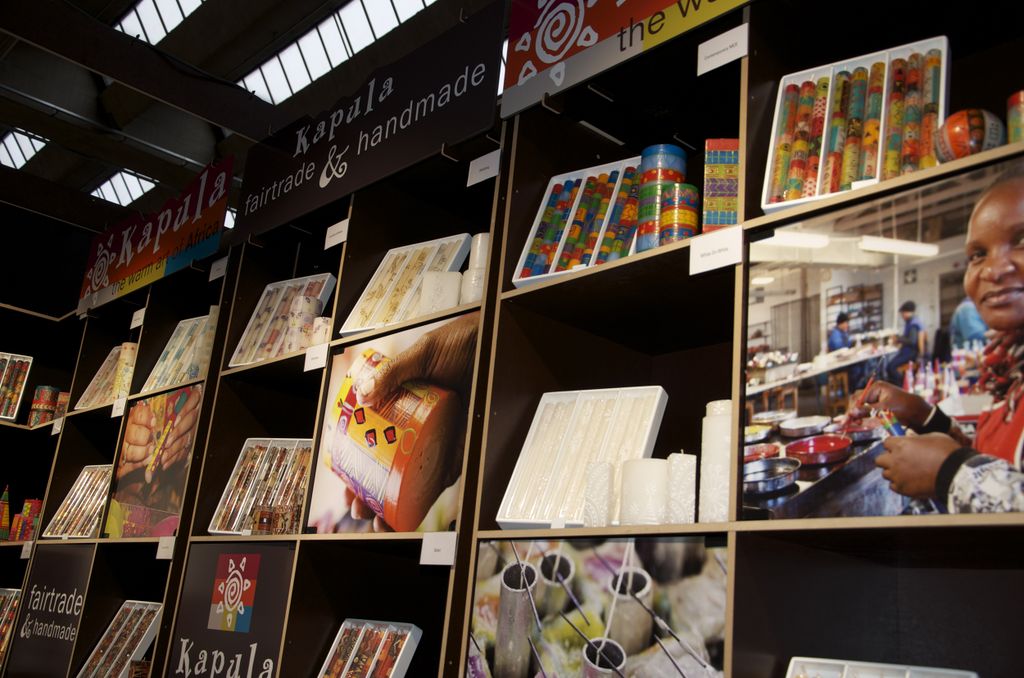
TRAVELLING SHOW: Kapula takes Martin Van Niekerk Photography's images abroad


Kapula's stand with my images and their hand-made candles at the
2103 Christmas Fair in Frankfurt, Germany earlier this year
If only this photographer could travel the world, the way the images I create for my clients, do!

Earlier this year Anke Appelgryn and the Kapula team trekked northwards from Bredasdorp to an icy cold Germany with their hand-made candles to participate in a major trade fair known to set international trends for festive decorations for the coming season.

And with it went several of the images I had shot for them, blown up to poster-size, to decorate the Kapula stall!

The 2013 Christmasworld expo took place from 25 to 29 January in Frankfurt and offered exhibitors from 66 countries an opportunity to introduce their products to the wholesale and retail trades including shops, florists, interior decorators and shop window specialists and designers. 


According to the organisers’ final report, Christmasworld 2013, with the two other expos that run concurrently namely Paperworld and Creativeworld, drew exhibitors from 66 countries and 83 600 visitors from 145 countries.

The Cristmasworld trade fair comprises ten different product groups including candles and fragrances. The others were Christmas decorations, annual and seasonal festive decoration (e.g. Easter, Halloween and religious objects), ribbons and wrapping, decorative gifts, florists' requisites, festive lighting, shop and display accessories, fireworks, party and festive articles.

Thanks Anke for supplying the photographs of the stall. It is great seeing my images helping to promote an exceptional product.  May the visitors’ visual experiences be converted into massive orders!


Close-up shots of the images


The Kapula stall